
A planting day is only the beginning of the story.

Machakos Fruit Tree Initiative 2026 — in partnership with Tree Adoption Foundation
A planting event lasts a few hours. What gets planted in that time can keep giving back for years — food, shade, learning, and a little more possibility for the people who tend it.
That's the simplest way to describe what happened in Machakos in June 2026, when Dovizia — the company behind tree-free, bamboo paper essentials like toilet paper, facial tissue, and kitchen towels — joined Tree Adoption Foundation and Machakos Teachers Training College for the Machakos Fruit Tree Initiative. It wasn't a single afternoon of digging holes and taking photos. It was the start of something meant to be cared for long after everyone went home.
What Happened, and Who Made It Happen
The initiative brought students, staff, and partner organizations together on the college grounds to plant fruit trees with a clear intention: this was about long-term value, not a one-day gesture. People showed up with placards bearing words like Integrity, Social Justice, and Love — small reminders that the day was as much about what the trees represent as what they'll eventually produce.

Students, staff and partners gather at the start of the Machakos Fruit Tree Initiative.
Dovizia was glad to take part, but this story doesn't belong to Dovizia. It belongs to the college that opened its grounds and its community, and to the organization that has spent years learning how to make tree planting actually last. Dovizia's role here was to contribute — funding, presence, and a willingness to follow the lead of people who understood the community far better than any visiting partner could.
Machakos Teachers Training College: A Community Built on Inclusion

Machakos Teachers Training College welcomed the initiative to its campus.
Machakos Teachers Training College is more than the venue for this initiative — it's a values-based institution that has built its identity around inclusion. Its student community includes blind and Deaf students, expectant students, and others whose educational journeys look different from the traditional path, and the college has shaped itself to meet them where they are rather than asking them to fit a single mould.
That's worth saying plainly, and saying with respect: these students are not defined by circumstance. They're teachers-in-training, organizers, and participants who showed up to plant something for their own community, on their own campus, alongside their peers.
Principal Madam Keziah Munioh welcomed the initiative with genuine hospitality and a clear interest in sustainability — not as a checkbox, but as something she saw fitting naturally into what the college already stands for. Her leadership set the tone for the day, and it's part of why the partnership felt less like an outside project landing on campus and more like a shared undertaking.
Tree Adoption Foundation: Local Knowledge, Long-Term Commitment
None of this works without an organization that understands what happens after the planting day ends, and that's where Tree Adoption Foundation came in. They're a growing, locally rooted organization focused on tree adoption and environmental stewardship, and their fingerprints were on every practical detail — from community relationships in the area to the coordination that got students actively involved rather than standing at the sidelines.

Young participants and scouts with Tree Adoption Foundation, whose local coordination anchored the day.
Tree Adoption Foundation brought something Dovizia couldn't have brought on its own: the local knowledge to choose the right species and sites, the relationships to make the day feel like community work rather than a corporate visit, and a track record of following through on tree care well past the ceremony. That last part matters most. Their commitment to what happens next — watering schedules, survival monitoring, ongoing care — is exactly the kind of responsible, lasting impact Dovizia looks for in a partner.
Why Fruit Trees
This is the part worth sitting with. Fruit trees were chosen deliberately, because they can offer more than shade and greenery over time.

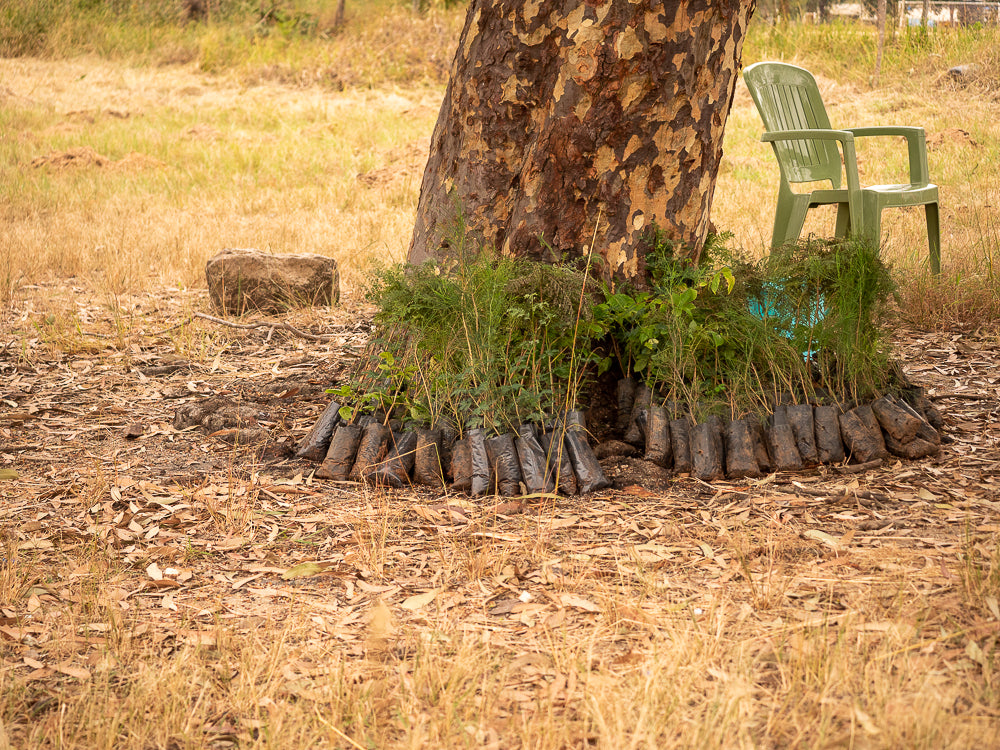
Partners hand over a fruit tree seedling during the planting ceremony.
As they mature, these trees have the potential to provide food and nutritional value for the college community. They'll offer shade that makes shared outdoor spaces more livable. They give students a living, ongoing subject for practical environmental learning — not a lesson in a textbook, but a tree they helped plant and can watch grow. And further down the road, as production increases, there may be opportunities to explore value-added products, and even small-scale skills or livelihood opportunities tied to that growth.
None of that is promised or guaranteed. What's certain is the planting; what comes after depends on care, time, and conditions that no one controls entirely. But the potential is real, and it's part of why fruit trees — rather than any other kind — were the right choice for this initiative. A shade tree gives back one thing. A fruit tree, tended well, can give back in several directions at once — which is exactly the kind of layered, patient impact this partnership was built around.
“This was not simply about planting trees; it was about planting nourishment, shade, learning and future possibility.”
Part of a Larger Vision
Dovizia's current commitment is straightforward: plant a tree for every case purchased. But tree planting is a starting point rather than the full limit of where Dovizia's stewardship thinking is headed. Over time, that direction may extend into areas like environmental restoration, biodiversity, water and waste, health, education, and community development — not all at once, and not by announcement, but by doing the work and letting the results speak.
It's worth spelling out what that actually looks like in practice. Every case of Dovizia's bamboo toilet paper, facial tissue, or kitchen towels bought by a household, an office, or a community space is tree-free by design — made from fast-growing bamboo instead of forest pulp — and it's also the mechanism behind days like the one in Machakos. Choosing the tree-free roll over the traditional one isn't a grand gesture on its own. But multiplied across enough kitchens and bathrooms, it's what turns a case of paper towels into a fruit tree seedling in a schoolyard.
The Machakos Fruit Tree Initiative is a useful example of how that plays out in practice, because a single planting day already touches several of those threads at once. There's the environmental piece, obviously - trees in the ground, biodiversity supported. There's health, in the fruit and shade those trees may eventually provide. There's education, in the hands-on learning students gained by participating directly rather than observing. There's community, in a partnership built on shared responsibility rather than one organization directing another. And there's the possibility, still distant but real, of future economic opportunity as the trees mature.
“Planting a tree can be one action, but its impact can reach far beyond the environment.”
That's the thinking behind how Dovizia wants to grow its impact — through credible partnerships, honest follow-up, and outcomes that can actually be measured, rather than a growing list of claims.
A Beginning, Not a Result
It would be easy to treat the planting day as the finished story — trees in the ground, photos taken, a good afternoon for everyone involved. But that's not quite right. The planting day was the beginning.
What happens next depends on things that unfold slowly and can't be rushed: how well the trees are cared for, whether they survive and take hold in the local soil, what fruit they eventually bear, and what learning and opportunity grow up around them as the years pass. Tree Adoption Foundation's ongoing involvement gives this initiative a real chance at that long-term outcome, and Machakos Teachers Training College's students are the ones who'll watch it unfold closest, season after season.
That's the honest way to close this story — hopeful about what these trees could become, grounded in the understanding that the real work is still ahead, and grateful to have been one contributing partner among several in getting it started.
Growing more than trees was always the point. What was planted in Machakos in June 2026 was a beginning worth watching — and if you're curious where the tree-free paper in your own home or office fits into that picture, that's a story Dovizia is always glad to share.


Leave a comment
All comments are moderated before being published.
This site is protected by hCaptcha and the hCaptcha Privacy Policy and Terms of Service apply.